







 Enviar artigo por via de e-mail
 Conflict of national images of World War II in the context of sociology of world wars
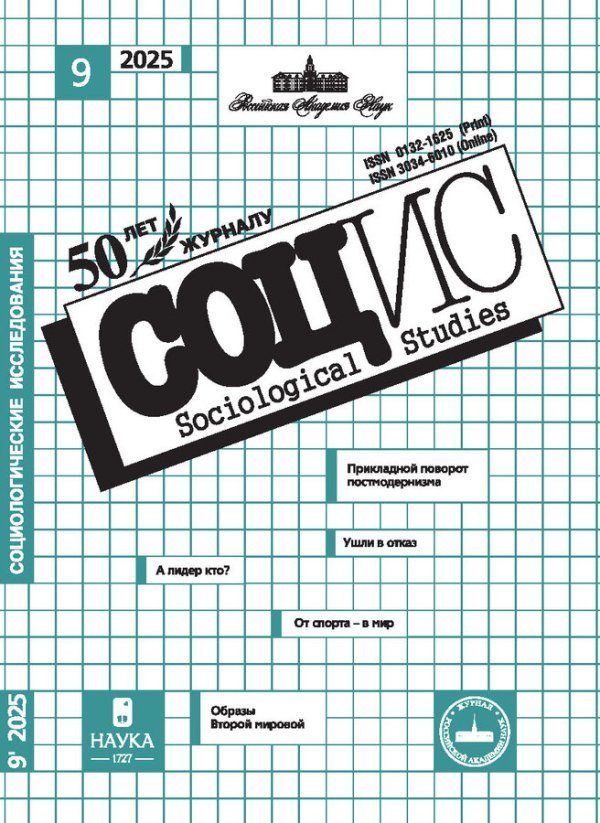
- Autores: Latov Y.V.1
-
Afiliações:
- Institute of Sociology of FCTAS RAS
- Edição: Nº 9 (2025)
- Páginas: 115-128
- Seção: DISCISSION. POLEMICS
- URL: https://gynecology.orscience.ru/0132-1625/article/view/697329
- DOI: https://doi.org/10.31857/S0132162525090109
- ID: 697329
Citar
Texto integral
 Acesso aberto
 Acesso está concedido
 Acesso é pago ou somente para assinantes

Resumo
The article presents a macrosociological approach to understanding world wars based on the world-system paradigm of social science in the form of a scientific essay. It supports the controversial thesis that in the history of modern and contemporary times there have been not two world wars, but significantly more. It is proposed to call world wars armed conflicts that are waged on a planetary scale, are characterized by large scales and, most importantly, have a strong influence on global world history. With this approach, the Thirty Years’ War of the 17th century can be considered the “Zero” World War, and the events associated with the Central Military District in Ukraine can be considered the “Third”. These conflicts occur periodically, since they are caused by the power competition of nation-states for leadership in the core of the modern world system. Russia’s increasing participation in these global conflicts, aimed at increasing its geopolitical independence, is due to the paradoxical combination from the 18th century to the present day of its economic backwardness from the West with high military force. This approach allows us to reject the opinion that World War II was supposedly a manifestation of a centuries-long conflict between Russia and the West, since in this, as in previous world wars, Russia fought against some Western countries in alliance with others. An overview of the strong differences in the memory of World War II in Russia, China and the West is given: all national images of history have deviations from the “academic” historical reality, but in different aspects. The world-system approach allows us to explain the modern struggle against the “falsification of World War II” as a clash of different national versions (images) of history, the differences between which are mainly not opportunistic, but objectively determined – in particular, a certain “bias” of all national versions of historical memory and its different significance in different countries-civilizations.
Palavras-chave
Bibliografia
- Безотосный В. М. Исторический ландшафт наполеоновских войн. Мировой конфликт и столкновение империй. М.: Кучково поле, ИКС–ХИСТОРИ, 2023.
- Валлерстайн И. Миросистемный анализ: Введение. М.: Территория будущего, 2006.
- Вторая мировая: что помним, о чем забыли // ВЦИОМ. 2020. 2 сентября. URL: https://wciom.ru/analytical-reviews/analiticheskii-obzor/vtoraya-mirovaya-chto-pomnim-o-chem-zabyli (дата обращения: 04.07.2025).
- Вторая мировая война: что мы о ней знаем? // ВЦИОМ. 2009. 31 августа. URL: https://wciom.ru/analytical-reviews/analiticheskii-obzor/vtoraya-mirovaya-vojna-chto-my-o-nej-znaem (дата обращения: 04.07.2025).
- Горшков М. К., Бараш Р. Э. Историческая память современных россиян (история России ХХ века сквозь призму семейных историй) // Социологические исследования. 2024. № 9. С. 125–137. doi: 10.31857/S0132162524090119.
- Карачкова Е. Ю. Диалоги с прошлым. Этноистория раджпутского княжества. М.: Совпадение, 2013.
- Кеннеди П. Взлеты и падения великих держав: Экономические изменения и военные конфликты в формировании мировых центров власти с 1500 по 2000 г. Екатеринбург: Гонзо, 2018.
- Коллинз Р. Насилие. Микросоциологическая теория. М.: НЛО, 2025.
- Ле Гофф Ж. История Европы, рассказанная детям. М.: Текст, 2010.
- Образцов И. В. Война как объект социологического анализа // Социологические исследования. 2020. № 10. С. 106–116. doi: 10.31857/S013216250010207-0.
- Пузанова Ж. В., Нарбут Н. П. и др. Типология исторической памяти о Второй Мировой войне: методологические аспекты изучения (на примере студенчества РУДН) // Вестник РУДН. Сер.: Социология. 2020. Т. 20. № 2. С. 292–306.
- Россияне о Второй мировой войне: причины, союзники, противники // ВЦИОМ. 2019. 29 августа. URL: https://wciom.ru/analytical-reviews/analiticheskii-obzor/rossiyane-o-vtoroj-mirovoj-vojne-prichiny-soyuzniki-protivniki (дата обращения: 04.07.2025).
- Турицын И. В. Феномен мировых войн: к общей постановке научной проблемы // Глобальная конфликтность и мировые войны: история и современность. М.: АНО «НИИИЭП», 2022. С. 3–17.
- 60-летие Победы: европейцы о Второй мировой войне // ВЦИОМ. 2005. 28 апреля. URL: https://wciom.ru/analytical-reviews/analiticheskii-obzor/60-letie-pobedy-evropejczy-o-vtoroj-mirovoj-vojne (дата обращения: 04.07.2025).
- Уайт Х. Практическое прошлое. М.: НЛО, 2024.
- Фальсификация истории Великой Отечественной войны: список статей. Курган, 2020.
- Chase-Dunn Ch.K., Podobnik B. The Next World War: World-System Cycles and Trends // Journal of World Systems Research. 1995. Vol. 1. Iss. 1. P. 295–326.
- Goldstein J. S. Long Cycles. Prosperity and War in the Modern Age. New Haven; L.: Yale University Press, 1988.
- Hamilton R. F., Herwig H. H. Ch. 1: World Wars: Definition and Causes // The Origins of World War I. Cambridge Univesity Press, 2003. Р. 1–44.
- Lederer E. ZurSoziologie des Weltkriegs // Archiv für Sozialwisseschaft und Sozialpolitik. 1915. B. 39. No. 2. S. 347–384. URL: https://www.researchgate.net/publication/328508518_On_the_Sociology_of_World_War (дата обращения: 04.07.2025).
- Mikaberidze A. The Napoleonic Wars: A Global History. Oxford, 2020.
- Wallerstein I. Decline of American Power: The U. S. in a Chaotic World. New Press, 2003.
Arquivos suplementares
